Thick Daejigukbab — Busan pork soup with rice ($21++)!
Korean Daejigukbab (돼지국밥) — Busan-style pork bone broth with sliced pork belly, chopped chives, mushrooms, with side banchan: kimchi, sliced chilli, garlic, salted shrimp.
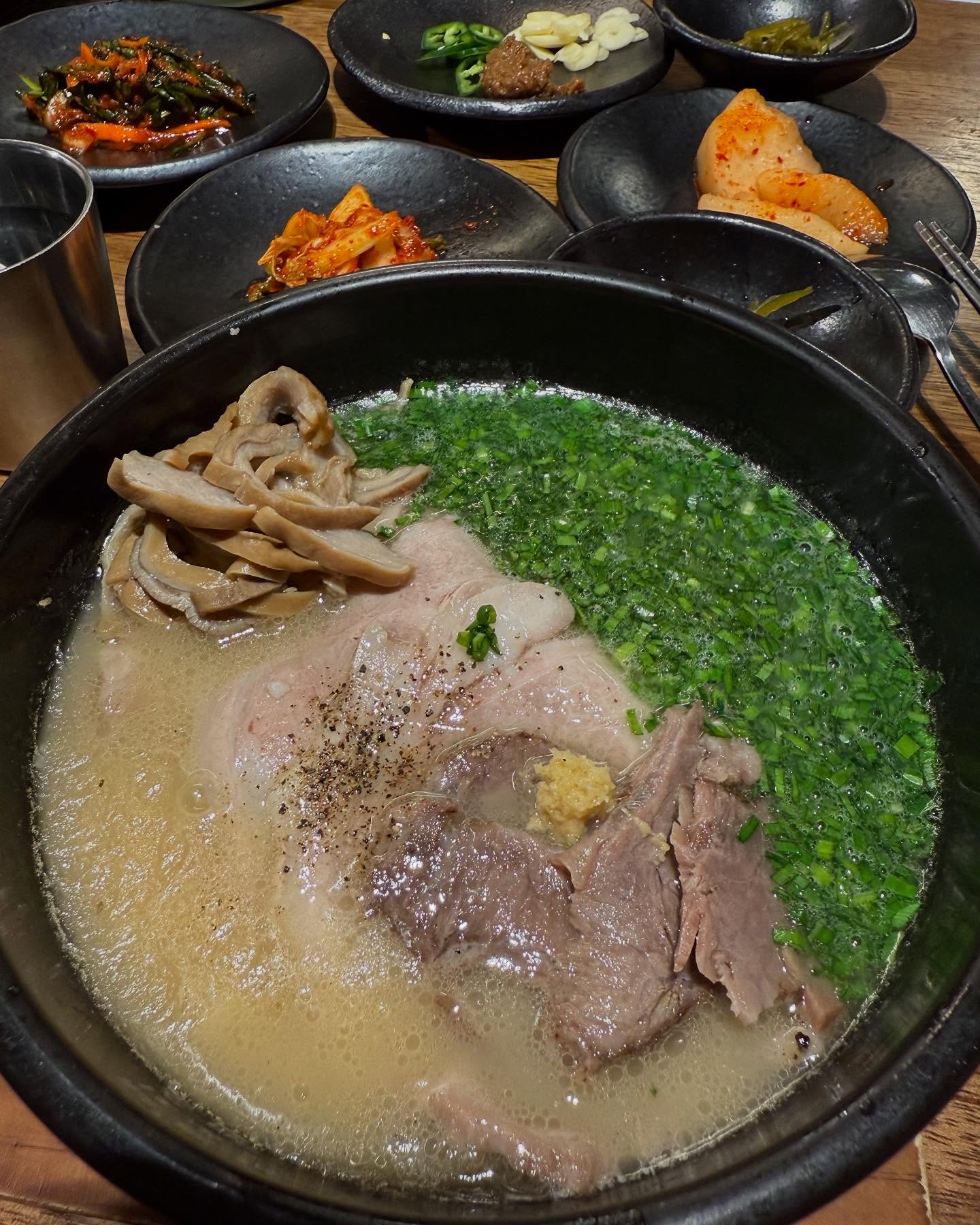
Lunch — thick Daejigukbab (돼지국밥) at $21++. The Busan pork soup specialty. 😋
What was on the table ($21++):
- A wide black stone bowl of Daejigukbab:
- Milky pork bone broth (tonkotsu-style) — boiled down for hours from pork bones, the natural emulsified milky-white colour.
- Sliced pork belly layered across the broth — paper-thin slices, half-cooked from the broth heat.
- Sliced pork shoulder (the second cut, more lean).
- Bright green chopped chives piled on top — the dish’s visual signature.
- Sliced beech mushrooms on the left.
- A dollop of mashed minced garlic (yellow) on the right.
- Cracked black pepper sprinkled across.
- Standard Korean banchan (top) — kimchi, sliced raw chillies, mashed garlic, salted shrimp (사 saewujeot), pickled radish.
Daejigukbab (돼지국밥) = “pig soup rice” — the Busan (South Korean port city) specialty soup. The dish is distinct from the more common Korean soups (kimchi jjigae, sundubu jjigae) because it focuses purely on the pork bone broth + sliced pork meat over rice. Comfort + protein + carb in one bowl.
Distinguishing features of Daejigukbab vs other pork soups:
- Milky-white broth (not red spicy or clear)
- Sliced pork (not stewed chunks) — added at the end so the meat stays tender
- Banchan separated — you customise spice level by adding kimchi/chilli yourself
- Rice served IN the soup (not on the side)
The “thick” version here = the premium upgrade — longer-boiled broth = more milky-rich. Standard daejigukbab uses lighter broth.
The eating ritual:
- Add the shrimp paste (saewujeot) for salt/umami
- Add kimchi + chillies for spice (your call)
- Add garlic for aroma
- Mix the rice into the broth
- Eat with the sliced pork
Without the banchan additions, the soup is intentionally bland-savoury — the bowl is designed for the diner to season. Korean restaurants serving Daejigukbab always provide the customisation banchan.
Beech mushrooms are the textural counterpoint — adds the chewy-soft contrast against the soft pork.
Chives = the bright herbal lift — Busan style uses lots of chopped chives (different from kimchi soup which uses scallions). The chives wilt into the broth + release oil.
At $21++ = mid-tier Korean restaurant pricing. Specialised Daejigukbab restaurants run $18-28 for this dish in SG.
Total: $21++ = roughly $25 after GST + service.
Overall: 4.3 / 5. Broth had proper milky depth, sliced pork was tender + plentiful, chives + mushrooms balanced, banchan customisation was the proper Korean experience. Will reorder when craving the milky pork comfort. 😋👍🏼